Last Updated on October 9, 2026 by Bakare Sherifdeen
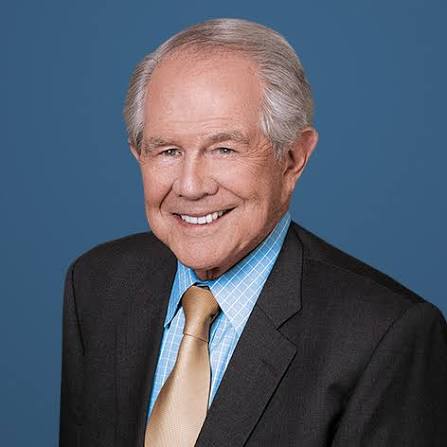
Pat Robertson was an American televangelist, Christian broadcaster, author, educator, and political activist who became one of the most recognizable figures in modern evangelical Christianity. Best known as the founder of the Christian Broadcasting Network (CBN) and the longtime host of The 700 Club, Robertson spent more than six decades building institutions that influenced Christian media, education, humanitarian outreach, and American politics.
Born Marion Gordon Robertson on March 22, 1930, in Lexington, Virginia, he grew up in a politically prominent family. His father, A. Willis Robertson, served in the United States Congress and Senate. Although Pat initially pursued higher education in law and served in the United States Marine Corps, his conversion to Christianity in the 1950s redirected his life toward religious ministry.
Robertson’s most significant achievement was transforming a small television ministry into an international Christian broadcasting organization. He also established Regent University, founded Operation Blessing, and created the American Center for Law and Justice. Through his television programme, books, and political activities, he reached millions of people and became a major voice in American evangelical life.
However, Robertson’s public career was not without controversy. His political positions and comments about natural disasters, international affairs, and social issues attracted criticism and generated debate about the responsibilities of religious leaders who hold significant public influence.
Pat Robertson died on June 8, 2023, at the age of 93. His life remains an important subject in the history of Christian broadcasting, evangelical leadership, and the relationship between religion and politics in the United States.
Key Takeaways
- Pat Robertson was born Marion Gordon Robertson on March 22, 1930, in Lexington, Virginia.
- He founded the Christian Broadcasting Network in 1960, with its first broadcast taking place in 1961.
- He became internationally recognized as the host of The 700 Club.
- He founded Regent University, Operation Blessing, and the American Center for Law and Justice.
- He married Adelia “Dede” Elmer in 1954, and they had four children.
- He sought the Republican presidential nomination in 1988 and became a prominent figure in conservative evangelical politics.
- His net worth was reported to exceed $100 million in an estimate discussed by The Washington Post, although a complete verified valuation of his estate is not publicly established.
- He died on June 8, 2023, leaving behind a substantial broadcasting and institutional legacy.
Pat Robertson at a Glance
Pat Robertson was a Christian leader whose work extended beyond preaching into television, higher education, humanitarian services, publishing, and political advocacy. His influence came largely from his ability to build organizations that continued operating beyond his personal appearances.
His story combines religious conviction, entrepreneurship, media innovation, and political engagement. While his supporters remember him for expanding Christian broadcasting and humanitarian work, his critics often focus on his political activism and controversial public statements.
Pat Robertson Quick Facts
| Quick Facts | Details |
|---|---|
| Full Name | Marion Gordon Robertson |
| Popular Name | Pat Robertson |
| Date of Birth | March 22, 1930 |
| Age at Death | 93 years (2023) |
| Place of Birth | Lexington, Virginia, United States |
| Date of Death | June 8, 2023 |
| Nationality | American |
| Religion | Christianity |
| Profession | Televangelist, broadcaster, author, educator, businessman |
| Father | A. Willis Robertson |
| Mother | Gladys Churchill Robertson |
| Wife | Adelia “Dede” Elmer Robertson |
| Marriage Year | 1954 |
| Children | Four |
| University Education | Washington and Lee University, Yale Law School, New York Theological Seminary |
| Major Organization | Christian Broadcasting Network |
| Famous Television Programme | The 700 Club |
| University Founded | Regent University, originally CBN University |
| Other Organizations | Operation Blessing, American Center for Law and Justice |
| Political Affiliation | Republican |
| Years Active | 1960s to 2021 in regular television hosting |
Early Life and Family Background
Marion Gordon Robertson was born on March 22, 1930, in Lexington, Virginia. He was raised in a family with a strong connection to American politics and public service. His father, Absalom Willis Robertson, commonly known as A. Willis Robertson, was a prominent Democratic politician who served in the United States House of Representatives and Senate. His mother was Gladys Churchill Robertson.
Growing up in a politically active family exposed Robertson to public affairs and the responsibilities associated with leadership. His father’s career placed the family close to discussions about government, public policy, and national affairs. These experiences provided a background that would later become relevant when Robertson entered political activism himself.
Robertson attended McCallie School, a preparatory school in Chattanooga, Tennessee. He subsequently enrolled at Washington and Lee University in Virginia, where he studied and graduated with honors in 1950. He was elected to Phi Beta Kappa, an academic honor society recognizing strong academic performance.
His early life did not immediately point toward a career as a television preacher. At the time, his education and family background appeared to prepare him for a professional career in law or public service.
Education and Military Service
After graduating from Washington and Lee University, Robertson served in the United States Marine Corps during the Korean War. He had enlisted in the Marine Corps Reserve in 1948 and later served with the First Marine Division as an assistant adjutant. He was promoted to first lieutenant in 1952.
His military experience exposed him to organizational discipline, leadership, and the demands of working within a structured institution. These skills would later prove useful as he developed a broadcasting organization and oversaw multiple educational and charitable initiatives.
Robertson continued his education at Yale Law School, earning a Juris Doctor degree in 1955. He later studied at New York Theological Seminary, where he received a Master of Divinity degree in 1959.
This combination of legal and theological education distinguished him from many religious broadcasters of his generation. It gave him an academic foundation that he later applied to Christian ministry, media leadership, education, and legal advocacy.
Pat Robertson’s Conversion and Calling to Ministry
Robertson’s move into Christian ministry followed a religious conversion during the 1950s. According to accounts published by CBN, he became a committed Christian through his encounter with evangelical Christianity and began to understand his future in terms of religious service.
His conversion changed the direction of his life. Instead of building a conventional career in law, he pursued a ministry that could reach people outside traditional church settings.
Robertson became convinced that television could serve as a powerful means of communicating the Christian message. Television allowed religious teaching, prayer, interviews, and personal testimonies to reach people in their homes, including viewers who might not regularly attend church.
At a time when religious broadcasting was still developing, this vision required both faith and business initiative. Robertson had to secure equipment, acquire a broadcasting station, attract financial supporters, and develop programmes that would keep audiences engaged.
His decision to pursue Christian television eventually led to the creation of CBN, the organization most closely associated with his life.
Founding the Christian Broadcasting Network
The Christian Broadcasting Network was established in 1960, marking the beginning of Robertson’s most important professional undertaking. He moved his young family to Portsmouth, Virginia, to pursue his broadcasting vision and acquire a struggling television station.
CBN’s historical account describes Robertson’s early financial resources as extremely limited. He nevertheless continued working to secure the equipment, funding, and support needed to launch a Christian television operation.
The network’s first broadcast took place on October 1, 1961. Its early programming faced the ordinary difficulties of a small broadcaster, including limited reach, financial pressure, and the challenge of building an audience.
Robertson’s ambition extended beyond local television. He wanted Christian programming to reach audiences across the United States and internationally. As cable and satellite distribution developed, CBN expanded its reach and became a significant Christian media organization.
The network produced programmes focused on biblical teaching, prayer, interviews, news, and religious commentary. It also became a platform for fundraising and humanitarian outreach.
CBN’s growth demonstrated Robertson’s ability to combine religious conviction with broadcasting, organizational management, and fundraising. The network eventually became a major part of the American Christian media landscape.
The 700 Club and Pat Robertson’s Rise to Fame
One of Robertson’s most enduring achievements was The 700 Club, CBN’s flagship television programme.
The programme’s origins can be traced to a fundraising telethon in 1963. Robertson sought 700 viewers willing to contribute $10 per month to support the network. This approach helped establish a community of recurring financial supporters and inspired the programme’s name.
By 1966, The 700 Club had developed into a regular television programme. Its format combined Christian teaching, prayer, interviews, personal testimonies, news, and commentary on public affairs.
Robertson’s direct and conversational presentation style helped him build a relationship with viewers. He addressed questions about faith, family, personal struggles, and current events, making the programme more than a conventional sermon broadcast.
As the programme’s audience grew, Robertson acquired a public platform that extended beyond religious teaching. He became a recognizable voice in discussions about American culture, politics, and international affairs.
His influence also brought criticism. Because the programme included political and social commentary, Robertson’s opinions could reach a broad audience and attract national attention. His public statements became part of wider debates about the role of evangelical leaders in American society.
Robertson eventually stepped back from full-time hosting. On October 1, 2021, he announced that his son Gordon Robertson would take over as the regular host. This transition marked the end of a defining chapter in his television career.
Regent University and His Contribution to Christian Education
Robertson’s ambitions extended into higher education. He established CBN University, which was incorporated in 1977 and began classes in 1978. The institution was later renamed Regent University.
His goal was to develop a university that would prepare students for professional and public leadership while grounding education in Christian values. The university expanded into areas such as law, business, communication, education, government, and theology.
Robertson served as the institution’s founder and chancellor. He believed Christian education could influence society by preparing graduates to work in different professions while maintaining their religious convictions.
Regent University became one of the most enduring institutions associated with his career. Unlike a television programme dependent on a particular host, the university was designed to educate successive generations of students and continue beyond its founder’s lifetime.
Its development also reflected Robertson’s broader approach to ministry. He sought to establish organizations that could communicate Christian beliefs not only through preaching but also through education, professional training, and public service.
Operation Blessing and Humanitarian Work
Robertson founded Operation Blessing, a humanitarian organization associated with disaster relief, medical assistance, food distribution, clean water projects, and community development.
The organization connected his broadcasting platform with practical assistance for people facing hardship. Through fundraising and relief initiatives, it developed humanitarian activities in the United States and internationally.
Robertson’s public profile helped bring attention to these initiatives and encouraged viewers to support charitable work. The organization became an important part of his broader vision of Christian service.
However, Robertson’s charitable and commercial activities sometimes attracted public scrutiny. Critics questioned aspects of his business dealings and the relationship between his wider enterprise and his religious mission. These concerns formed part of the public debate surrounding his career.
Even so, Operation Blessing remained one of the major institutions associated with his legacy, reflecting his belief that religious ministry should include practical assistance to people in need.
American Center for Law and Justice
Robertson founded the American Center for Law and Justice (ACLJ), a legal advocacy organization focused on religious liberty, constitutional issues, and conservative legal causes.
The organization became known for defending religious expression and representing clients in disputes involving the relationship between religion and public life. Its work reflected Robertson’s belief that Christians should be able to express and practise their faith within American public institutions.
The ACLJ extended his influence beyond broadcasting and education into legal and constitutional debates. It also aligned with his wider political outlook, which emphasized religious freedom and conservative interpretations of public policy.
Through this organization, Robertson helped establish a lasting presence in the legal advocacy landscape. Its activities became part of the broader network of institutions associated with his ministry and political commitments.
Pat Robertson’s Books and Publications
Robertson was also a prolific author who wrote about Christian faith, personal development, politics, economics, and biblical interpretation. His books helped extend his influence to readers who wanted to explore his ideas outside television.
Some of his notable publications include:
- Shout It from the Housetops, an autobiographical account of his religious journey and early ministry.
- The Secret Kingdom, which presents principles Robertson believed were important for living according to God’s purposes.
- The New World Order, which examines international politics and Robertson’s interpretation of global developments.
- Answers to 100 of Life’s Most Probing Questions, addressing questions about Christian belief and practical life.
- The End of the Age, a novel incorporating biblical end-times themes.
- The Plan, which discusses his presidential campaign and his views on Christian participation in public life.
His publications covered a wide range of subjects, reflecting the breadth of his interests. Some focused on spiritual growth, while others addressed political change, cultural developments, and biblical prophecy.
His books also helped preserve his views for future readers, contributing to his legacy as a Christian communicator as well as a broadcaster.
Pat Robertson’s Wife and Marriage
Pat Robertson married Adelia Elmer, known as Dede Robertson, in 1954. Their marriage lasted 67 years, until Dede died on April 19, 2022, at the age of 94.
Dede shared much of the family journey that accompanied Robertson’s ministry. As he developed CBN and expanded into education and humanitarian initiatives, their family life unfolded alongside the demands of his public career.
The couple had four children and later became grandparents and great-grandparents. Their long marriage was an important part of Robertson’s personal story, particularly during the early years when he was establishing a broadcasting operation with limited resources.
Dede died a little over a year before her husband. Robertson’s death in June 2023 brought an end to a marriage that had lasted nearly seven decades.
Pat Robertson’s Children and Family Life
Pat and Dede Robertson had four children:
- Timothy Brian Robertson
- Elizabeth Robertson Robinson
- Gordon Perry Robertson
- Ann Robertson LeBlanc
Their children developed their own careers and family lives, although some remained connected to organizations associated with their father’s work.
Gordon Robertson became particularly prominent in CBN. He assumed the role of regular host of The 700 Club in 2021 and held leadership responsibilities within the network. His involvement helped maintain continuity as Pat Robertson reduced his daily broadcasting duties.
According to CBN’s obituary, Pat Robertson was survived by four children, 14 grandchildren, and 24 great-grandchildren. His family therefore formed a significant part of the personal legacy he left behind.
Pat Robertson’s Political Career and the 1988 Presidential Campaign
Robertson became a major figure in conservative evangelical politics, particularly during the 1980s and 1990s.
In 1987, he announced his campaign for the Republican Party’s presidential nomination for the 1988 election. He sought to mobilize conservative Christian voters and argued that religious values should play a role in American public life.
His campaign attracted substantial support and demonstrated the political potential of the evangelical audience he had developed through broadcasting. He performed competitively in early contests but ultimately lost the nomination to George H. W. Bush.
Although he did not become president, the campaign strengthened his profile as a political organizer and showed how religious broadcasting could help mobilize voters.
Robertson was also closely associated with the Christian Coalition, established in 1989. The organization encouraged conservative Christians to participate in elections, distributed voter guides, and advocated policies aligned with its social and political priorities.
Supporters saw Robertson’s political work as an effort to ensure that Christian concerns were represented in government. Critics argued that his activities blurred the boundary between religious ministry and partisan politics, especially when the resources and visibility of religious organizations intersected with political campaigning.
His political career remains a significant part of the history of the modern American religious right.
Pat Robertson’s Controversies and Public Criticism
Robertson’s influence was accompanied by recurring controversy. His statements about politics, international affairs, and disasters sometimes drew strong criticism from religious leaders, journalists, and members of the public.
Comments Following the Haiti Earthquake
One of his most widely criticized statements came after the January 2010 earthquake in Haiti. During The 700 Club, Robertson suggested that Haiti’s suffering was linked to an alleged pact with the devil associated with the country’s struggle against French colonial rule.
The comments were widely condemned as insensitive and historically misleading. Critics argued that attributing a devastating natural disaster to a supposed spiritual failing was inappropriate, especially while people were facing death, injury, and widespread destruction.
The episode became one of the most frequently cited controversies of his public career.
Political and Social Statements
Robertson regularly commented on American elections, social issues, foreign policy, and international events. His supporters appreciated his willingness to express conservative Christian views, while critics argued that some of his remarks were inflammatory and could deepen political or religious divisions.
His position as a prominent television broadcaster amplified the impact of his statements. His comments were often discussed beyond evangelical audiences and became part of broader debates about religious influence in public life.
Questions About Business and Ministry
Robertson’s business activities and the growth of his media enterprise also attracted scrutiny. Journalists examined the relationships between his charitable activities, broadcasting organizations, and political ambitions.
These issues illustrate the challenges that can arise when religious leaders oversee multiple organizations with different financial, legal, and public responsibilities. A fair assessment of Robertson’s life should acknowledge both his institution-building achievements and the criticism associated with his public activities.
Pat Robertson’s Net Worth
Pat Robertson accumulated substantial wealth through his involvement in media, business ventures, publishing, and other commercial activities. His financial history is closely connected to the growth of Christian broadcasting and his role in International Family Entertainment, the company associated with The Family Channel.
In 1997, International Family Entertainment was sold to a division of Fox for approximately $1.9 billion. The transaction was a major event in the history of Christian-related television businesses, although the company’s sale price should not be mistaken for Robertson’s personal net worth.
The Washington Post reported in its 2023 obituary that Forbes had estimated Robertson’s wealth at more than $100 million. This figure is a reported public estimate, not a verified accounting of every asset, liability, or estate distribution.
His wealth was associated with several areas:
- Media and broadcasting investments.
- Commercial ventures linked to television.
- Book publishing and royalties.
- Business interests accumulated during his career.
- Other personal investments and assets.
It is important to distinguish his personal wealth from the funds and property of nonprofit organizations such as CBN, Regent University, and Operation Blessing. The assets of these institutions should not automatically be treated as Robertson’s private property.
Based on the publicly reported estimate, Pat Robertson’s net worth was estimated to exceed $100 million. However, the exact value of his estate at death has not been established through a comprehensive public accounting.
Pat Robertson’s Death and Legacy
Pat Robertson died on June 8, 2023, at his home in Virginia Beach, Virginia, at the age of 93. CBN announced his death and remembered him as a religious broadcaster, educator, author, philanthropist, and Christian leader.
His death marked the end of a career that had helped reshape American Christian broadcasting. The institutions he established gave his influence a reach that extended beyond his television appearances and personal ministry.
His legacy can be understood through four major contributions.
First, he helped make Christian television a major platform for religious teaching, prayer, and fundraising. CBN and The 700 Club became lasting examples of how broadcasting could expand a ministry’s audience.
Second, he established institutions that operated in education, humanitarian relief, and legal advocacy. Regent University, Operation Blessing, and the American Center for Law and Justice reflected his ambition to extend Christian influence into several areas of public life.
Third, he helped mobilize conservative evangelical voters and contributed to the development of the modern religious right. His presidential campaign and political organizing demonstrated the connection between religious broadcasting and political participation.
Finally, his controversies remain part of his historical record. His political positions and public comments generated criticism, reminding observers that influential religious leaders can be judged both by the institutions they build and by the consequences of their words and actions.
Pat Robertson’s life therefore represents a complex chapter in American religious history. He was an ambitious institution builder whose work influenced broadcasting, education, charity, and politics, while his controversial public statements ensured that his legacy would remain debated.
Frequently Asked Questions About Pat Robertson
1. Who was Pat Robertson?
Pat Robertson was an American televangelist, broadcaster, author, educator, and political activist. He founded the Christian Broadcasting Network, hosted The 700 Club, and established organizations involved in Christian education, humanitarian work, and legal advocacy.
2. How old was Pat Robertson when he died?
Pat Robertson was 93 years old when he died on June 8, 2023. He was born on March 22, 1930.
3. What was Pat Robertson’s net worth?
Pat Robertson’s net worth was reported to exceed $100 million, according to a public estimate discussed in The Washington Post‘s 2023 obituary. This is an estimate rather than a verified valuation of his estate.
4. Who was Pat Robertson’s wife?
Pat Robertson’s wife was Adelia “Dede” Elmer Robertson. They married in 1954 and were together for 67 years before Dede died in April 2022.
5. How many children did Pat Robertson have?
Pat Robertson had four children: Timothy Brian Robertson, Elizabeth Robertson Robinson, Gordon Perry Robertson, and Ann Robertson LeBlanc.
6. What was Pat Robertson famous for?
He was best known for founding the Christian Broadcasting Network and hosting The 700 Club. He was also known for founding Regent University and Operation Blessing and for his role in conservative evangelical politics.
7. What was the Christian Broadcasting Network?
The Christian Broadcasting Network is a Christian media organization founded by Robertson in 1960. Its first television broadcast took place on October 1, 1961. It became known for religious programming, news, humanitarian outreach, and The 700 Club.
8. Did Pat Robertson run for president?
Yes. Robertson sought the Republican Party’s presidential nomination in 1988. His campaign attracted support among conservative evangelical Christians, but he ultimately lost the nomination to George H. W. Bush.
9. What university did Pat Robertson found?
He founded CBN University, which began classes in 1978 and was later renamed Regent University. The institution developed programmes across several academic and professional fields.
10. What books did Pat Robertson write?
His books included Shout It from the Housetops, The Secret Kingdom, The New World Order, Answers to 100 of Life’s Most Probing Questions, The End of the Age, and The Plan.
11. Why was Pat Robertson controversial?
Robertson was criticized for some political positions and public statements about international affairs and natural disasters. His remarks following the 2010 Haiti earthquake attracted particularly strong condemnation.
12. What organizations did Pat Robertson establish?
His major institutional contributions included the Christian Broadcasting Network, Regent University, Operation Blessing, and the American Center for Law and Justice. He was also involved in International Family Entertainment.
13. When did Pat Robertson stop hosting The 700 Club?
Robertson stepped back from full-time hosting in October 2021. His son Gordon Robertson became the programme’s regular host.
14. What was Pat Robertson’s father’s occupation?
His father, A. Willis Robertson, was an American politician who served in the United States House of Representatives and Senate.
15. What is Pat Robertson’s legacy?
Robertson’s legacy includes the growth of Christian television, the establishment of Christian educational and humanitarian institutions, and the political mobilization of conservative evangelicals. His controversial statements and political activities also remain part of assessments of his career.
Conclusion
Pat Robertson was a prominent Christian broadcaster whose career extended across television, education, humanitarian work, publishing, business, and politics. From founding CBN to hosting The 700 Club and establishing Regent University, he created institutions that influenced American evangelical life for decades.
His achievements were substantial, but his public career also generated controversy, particularly through his political activism and statements about major events. Understanding his legacy requires acknowledging both his contribution to Christian broadcasting and the debates surrounding his influence.
Although Robertson died in 2023, the organizations he established and the broadcasting model he helped develop remain part of the history of modern Christianity.
Explore More on BelieversBio
- David Oyedepo Biography: Discover the life, family, ministry, church, and wealth of one of Africa’s most influential Christian leaders.
- Billy Graham Biography: Explore the life and legacy of the renowned evangelist whose preaching influenced millions of Christians worldwide.
- Joel Osteen Biography: Learn about the pastor’s family, ministry, Lakewood Church, books, and rise to prominence in Christian broadcasting.
- Charles Stanley Biography: Discover the life, teachings, ministry, and lasting influence of the respected American pastor and Bible teacher.
References
- Christian Broadcasting Network (CBN), Pat Robertson Official Biography
- Christian Broadcasting Network (CBN), Pat Robertson Official Obituary
- Regent University, Pat Robertson Founder Biography
- The Washington Post, Pat Robertson Obituary, June 2023
- United States Senate, Report on Activities Connected to Federal Election Campaigns
- Los Angeles Times, Reporting on Pat Robertson’s Political Campaign

Bakare Sherifdeen is the Founder and Publisher of BelieversBio, a Christian reference platform dedicated to publishing well-researched biographies of pastors, evangelists, Christian authors, churches, ministries, and influential Christian leaders worldwide.
He has over six years of experience in SEO, WordPress development, technical SEO, and digital publishing. His work focuses on producing accurate, thoroughly researched, and trustworthy content that helps readers better understand the people and organizations shaping Christianity today.
Through BelieversBio, he is committed to maintaining high editorial standards by verifying information with reliable sources and updating articles to ensure long-term accuracy and usefulness.